
Factory or Trader? How to Verify a Real Coconut Charcoal Manufacturer
Most coconut charcoal 'suppliers' on B2B marketplaces are traders, not factories. Here's how to tell the difference — and why it decides your consistency, price, and who answers when a batch goes wrong.
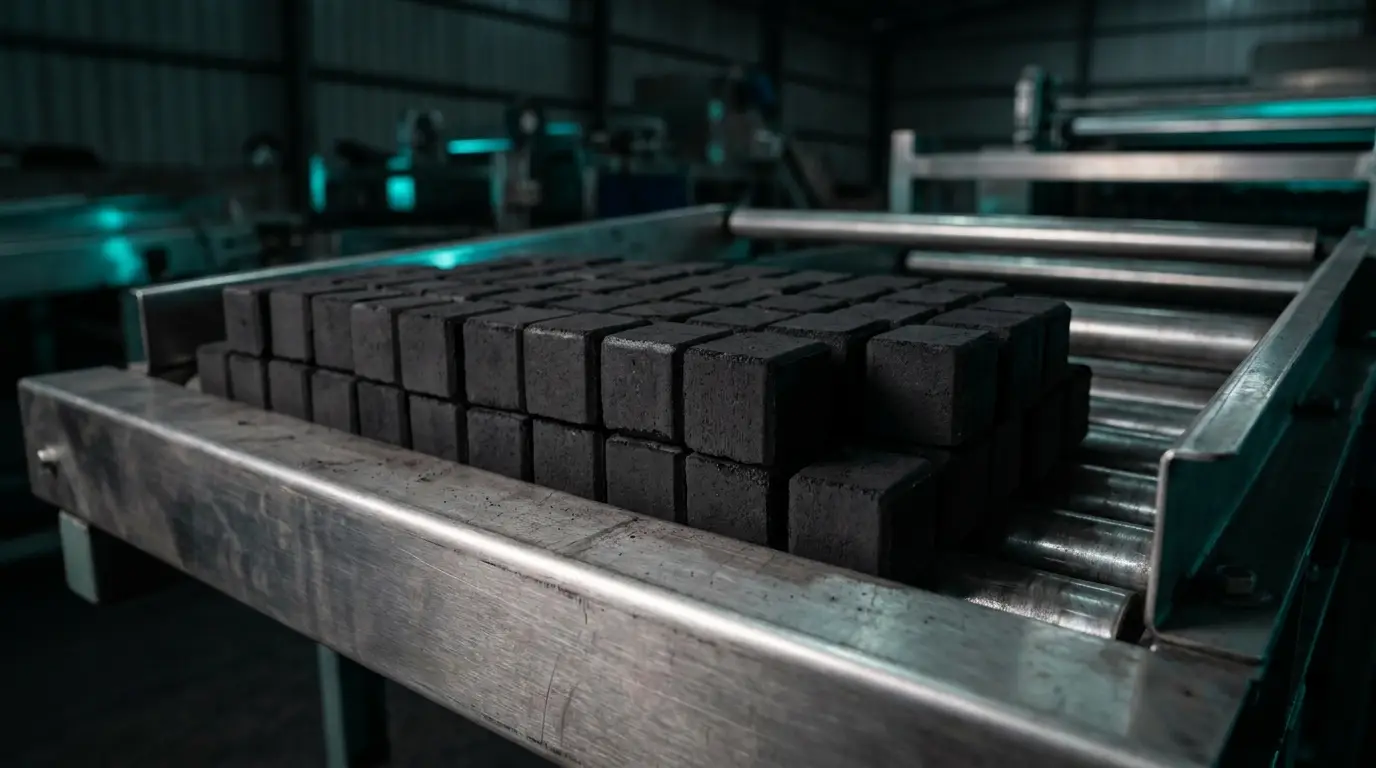
Ask ten coconut charcoal suppliers for a quote and you will get ten confident replies. What you will not get, in most cases, is a factory. You will get traders — intermediaries who buy whatever is cheapest that month and resell it under a catalogue that looks exactly like a manufacturer’s.
For a distributor this is the single most important thing to establish before a first order, because almost everything you care about — price, consistency, accountability — is decided by whether the name on your invoice actually made the charcoal.
Why it matters more than the price
A trader has no line to control and no name on the box. When shell prices move, they move batch to batch to protect their margin — which means the charcoal you approved in a sample can arrive burning differently three months later. There is no one to hold responsible, because the trader did not make it and the real factory never met you.
A factory has the opposite incentive. It runs one process, it puts its own reputation on every container, and it wants you buying for years, not once. Consistency is the product in this business, and only the producer can promise it.
There is also a price effect. Every trader in the chain adds a margin, so a middleman’s “wholesale” price already carries a markup you cannot see. Going factory-direct removes it.
The questions that separate the two
You rarely need more than one conversation. A genuine manufacturer answers these without hesitation; a trader starts to hedge.
- “Which factory produces this, and can I see it?” A producer offers a live video walk of the carbonisation and pressing line on request — ours is on the factory page. A trader offers reasons why that is not possible right now.
- “Whose name is on the ISO 9001 certificate?” It should be their legal entity — not a certificate for a company you have never heard of.
- “Is the charcoal I sampled the charcoal I will get in twelve months?” A factory says yes and explains how it holds ash and density stable. A trader cannot promise what it does not control.
- “Can you produce our brand under private label?” Real private-label production means owning the line — moulds, printing, packing. Traders quietly outsource it, and the quality drifts.
How to verify in practice
Talk is cheap; a few checks are not.
- Match the legal name across records. The name on the quote, the ISO certificate, the business registration and the bank account should all be the same entity. Mismatches are the classic trader signature — you pay one company and a different one ships.
- Ask for a recent lab report with a tested ash figure — not a spec sheet. Premium coconut shell charcoal sits around 1.8–2.0% ash; a producer proves it on paper. (See what ash content actually tells you.)
- Request a sample from current stock, then a second one a month later. Two consistent samples from the same source is the strongest signal you will get short of visiting.
- Check the certificates are held by the seller, not screenshots of someone else’s. Import documentation in the seller’s own name is what clears customs cleanly.
Where IZZY COCO sits
We are not a broker. IZZY COCO coconut charcoal is produced at our own factory in Indonesia — one line, one standard, a consistent 1.8–2.0% ash, ISO 9001, lab-tested batch to batch, and shipped factory-direct to 19+ countries. When you buy from us you are talking to the people who make it, which is the entire point of this article.
FAQ
How do I know if a coconut charcoal supplier is a factory or a trader?
Ask to see the production line on a live video call, and check that the ISO 9001 certificate, business registration and bank account all carry the same legal name as the quote. A real manufacturer shows its line and matches its paperwork; a trader avoids the video and often bills under a different entity than the one that ships.
Is it cheaper to buy coconut charcoal factory-direct?
Usually yes. Every intermediary in the chain adds a hidden margin, so a trader’s “wholesale” price already includes a markup. Buying direct from the producer removes those layers — the saving is often the trader’s entire cut.
Why does buying from the actual factory improve consistency?
The factory controls one carbonisation and pressing process and puts its own name on every container, so it has every reason to keep ash and density stable over years. A trader sources spot batches wherever they are cheapest that month, so quality drifts between shipments.
What paperwork should a real manufacturer provide?
ISO 9001 in their own name, an independent lab report with a tested ash and burn-time figure, and a Certificate of Origin with every shipment. If certificates belong to a company you cannot identify, treat that as your answer.