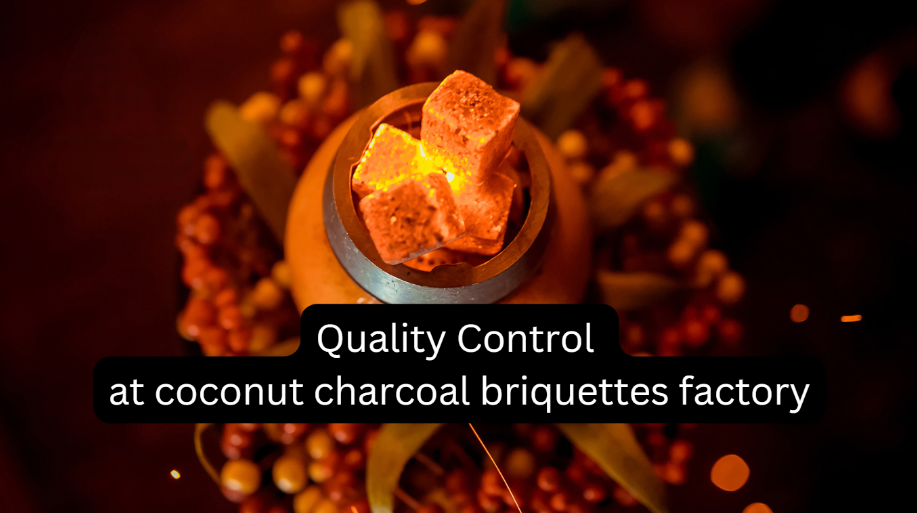
Quality Control for Coconut Charcoal Briquettes for Shisha
How can we make sure that the quality & specification of our hookah coals are the same in each container? Coconut Charcoal Briquettes Quality Control – 7-Step Process for Wholesale Shisha Charcoal Buyers
Our coconut charcoal factory places great emphasis on quality control and implements an extensive 7-step inspection process throughout the production of shisha charcoal.
We conduct in-house and third-party independent lab testing, which ensures that we consistently produce high-quality coconut charcoal briquettes for shisha with an ash content of no more than 1.6% and a burn time of 2+ hours. In addition, we maintain a fixed carbon level of 85-92%, which makes our shisha charcoal odorless and burns for a long time at a very high temperature.
Not only lab and field testing, but our charcoal factory is also certified by the international quality management standard ISO 9001 .
We conduct in-house and third-party independent lab testing, which ensures that we consistently produce high-quality coconut charcoal briquettes for shisha with an ash content of no more than 1.6% and a burn time of 2+ hours. In addition, we maintain a fixed carbon level of 85-92%, which makes our shisha charcoal odorless and burns for a long time at a very high temperature.
Not only lab and field testing, but our charcoal factory is also certified by the international quality management standard ISO 9001 .
In order to ensure that our wholesale hookah coal buyers can sell our product and enjoy quality hookah smoking, there are several key parameters that need to be checked when choosing hookah coal.
All these parameters are constantly checked by our factory quality control team.
Again, we have a dedicated quality control team that checks the parameters during all production processes. Starting from the receipt of raw materials (coconut shell charcoal): checking the fixed carbon (should be 87%, ideally 92%) and tapioca (tested for smell by keeping it in a closed bottle for 24 hours in a heated state. If there is no smell after 24 hours, this tapioca is suitable for use in production).
First, we check for odor and sparks: Using odorless and sparkless coconut charcoal for hookah is very important, as it ensures that the coal will not emit any unwanted odors or sparks during use. Experience the highest quality coconut charcoal for shisha with our coconut charcoal factory. Our 7-step quality control process and in-house and independent lab testing guarantee ash content of 1.6% or less and a burn time of 2+ hours.
All these parameters are constantly checked by our factory quality control team.
Again, we have a dedicated quality control team that checks the parameters during all production processes. Starting from the receipt of raw materials (coconut shell charcoal): checking the fixed carbon (should be 87%, ideally 92%) and tapioca (tested for smell by keeping it in a closed bottle for 24 hours in a heated state. If there is no smell after 24 hours, this tapioca is suitable for use in production).
First, we check for odor and sparks: Using odorless and sparkless coconut charcoal for hookah is very important, as it ensures that the coal will not emit any unwanted odors or sparks during use. Experience the highest quality coconut charcoal for shisha with our coconut charcoal factory. Our 7-step quality control process and in-house and independent lab testing guarantee ash content of 1.6% or less and a burn time of 2+ hours.
The most important thing is the absence of smell. This is the main reason why coconut charcoal is used as hookah coal.
You can read about the reasons why hookah coals can smell in my article here. If you do not have time to read it, just remember that a high level of carbonation, good tapioca and strict adherence to production processes will keep your coals from smelling.
Secondly, a long burn time: a long burn time of more than 2 hours ensures longer hookah smoking without the need for frequent coal replacement. Our 25 mm cube can last up to 2 hours 15 minutes, 28 cube - up to 2 hours 45 minutes.
For a long burn, it is very simple - just do not mix your coconut charcoal with wood. Why do other factories mix it with wood? Just to cut costs. Charcoal costs 1/4 of the cost of coconut shell coal.
That is why – be careful if someone offers you cheap charcoal. It may be mixed with wood.
Third: Low Ash Content: Low ash content results in higher temperature and better taste of hookah tobacco.
We maintain the initial combustion temperature at 650 – 750 degrees Celsius. High and stable combustion temperature helps to maintain a consistent hookah smoking experience, without temperature fluctuations affecting the taste and smoke output. Again, it is very important to maintain a consistently high temperature while smoking hookah
Let's get started. Strength and Durability: It is important that the coals are strong, do not crack or break when dropped, to ensure a stable and consistent smoking. There are no cracks on the charcoal, it does not need to be replaced.
You can read about the reasons why hookah coals can smell in my article here. If you do not have time to read it, just remember that a high level of carbonation, good tapioca and strict adherence to production processes will keep your coals from smelling.
Secondly, a long burn time: a long burn time of more than 2 hours ensures longer hookah smoking without the need for frequent coal replacement. Our 25 mm cube can last up to 2 hours 15 minutes, 28 cube - up to 2 hours 45 minutes.
For a long burn, it is very simple - just do not mix your coconut charcoal with wood. Why do other factories mix it with wood? Just to cut costs. Charcoal costs 1/4 of the cost of coconut shell coal.
That is why – be careful if someone offers you cheap charcoal. It may be mixed with wood.
Third: Low Ash Content: Low ash content results in higher temperature and better taste of hookah tobacco.
We maintain the initial combustion temperature at 650 – 750 degrees Celsius. High and stable combustion temperature helps to maintain a consistent hookah smoking experience, without temperature fluctuations affecting the taste and smoke output. Again, it is very important to maintain a consistently high temperature while smoking hookah
Let's get started. Strength and Durability: It is important that the coals are strong, do not crack or break when dropped, to ensure a stable and consistent smoking. There are no cracks on the charcoal, it does not need to be replaced.
Independent quality control by laboratory
In addition to our own quality control measures, our charcoal is regularly assessed by an independent quality control laboratory to check the quality of our coconut charcoal briquettes.
This helps us cross-check and calibrate our lab. We send a portion of our charcoal to this lab once a week to double-check and ensure the accuracy of our own quality control.
This helps us cross-check and ensure that our charcoal briquettes meet standards.
The lab conducts rigorous tests to determine the ash content, moisture content, calorific value, and volatile matter of the charcoal.
This helps us cross-check and calibrate our lab. We send a portion of our charcoal to this lab once a week to double-check and ensure the accuracy of our own quality control.
This helps us cross-check and ensure that our charcoal briquettes meet standards.
The lab conducts rigorous tests to determine the ash content, moisture content, calorific value, and volatile matter of the charcoal.
7 steps of quality control process
Our quality control consists of 7 steps of internal quality control procedure, which includes:
1. raw material quality check (moisture, ash content, ash color, carbonization level, volatile matter) - coconut shell charcoal
2. mesh material quality check (cell size, cell density)
3. quality check before and after mixing for color and ash content
4. At the extrusion stage, we conduct quality check for viscosity, density, stretch, compression, elasticity, hardness, flexibility, brittleness.
5. Cutting stage: we check the size of the briquettes, unevenness, roughness of the product, ash content and ash color
6. Pre- and post-stage: we check the moisture, ash granule content, ash content, ash color, self-heating ability, burning time, initial temperature, final temperature.
7. Post-package quality check in independent laboratory and random check of final product 1 week after packaging
1. raw material quality check (moisture, ash content, ash color, carbonization level, volatile matter) - coconut shell charcoal
2. mesh material quality check (cell size, cell density)
3. quality check before and after mixing for color and ash content
4. At the extrusion stage, we conduct quality check for viscosity, density, stretch, compression, elasticity, hardness, flexibility, brittleness.
5. Cutting stage: we check the size of the briquettes, unevenness, roughness of the product, ash content and ash color
6. Pre- and post-stage: we check the moisture, ash granule content, ash content, ash color, self-heating ability, burning time, initial temperature, final temperature.
7. Post-package quality check in independent laboratory and random check of final product 1 week after packaging
The raw material for coconut charcoal is coconut shell.
Firstly, our quality control team checks the raw materials. We only use natural coconut charcoal shells. This is a natural product and can naturally vary in its properties.
Depending on the region where the coconut was grown, the season (wet or dry season) for using coconut charcoal shells can vary greatly.
Our factory has its own charcoal burning plant on Halmahera Island, but due to the large volume of production, we have to additionally purchase coconut charcoal from independent farmers.
This is why we are 100% sure that all coconut charcoal shells are good and meet the standards of our factory.
One of the key aspects of quality control for coconut charcoal briquettes is to ensure the high quality of the raw materials used.
This includes selecting coconuts that are free of mold and rot, as well as ensuring that the charcoal used in the briquettes is clean and free of contaminants.
In addition, we test the carbon content to ensure that it burns perfectly.
We check:
• Moisture,
• Ash content,
• Ash color
• Carbon value
• Calorific value
After the coconut charcoal is checked by the quality control team, it is sent to the crushing complex in the second production area.
The second production facility is located 500 meters away from the main production facility. The coconut shell charcoal is checked, separated and sieved.
We use industrial grade automatic screens of 8 and 12 meters in length. This helps to keep the charcoal clean from any contaminants except the charcoal materials.
After sieving, the raw materials are crushed and turned into powder. By the way, our quality control department also checks and measures the mesh size to maintain it constant.
Depending on the region where the coconut was grown, the season (wet or dry season) for using coconut charcoal shells can vary greatly.
Our factory has its own charcoal burning plant on Halmahera Island, but due to the large volume of production, we have to additionally purchase coconut charcoal from independent farmers.
This is why we are 100% sure that all coconut charcoal shells are good and meet the standards of our factory.
One of the key aspects of quality control for coconut charcoal briquettes is to ensure the high quality of the raw materials used.
This includes selecting coconuts that are free of mold and rot, as well as ensuring that the charcoal used in the briquettes is clean and free of contaminants.
In addition, we test the carbon content to ensure that it burns perfectly.
We check:
• Moisture,
• Ash content,
• Ash color
• Carbon value
• Calorific value
After the coconut charcoal is checked by the quality control team, it is sent to the crushing complex in the second production area.
The second production facility is located 500 meters away from the main production facility. The coconut shell charcoal is checked, separated and sieved.
We use industrial grade automatic screens of 8 and 12 meters in length. This helps to keep the charcoal clean from any contaminants except the charcoal materials.
After sieving, the raw materials are crushed and turned into powder. By the way, our quality control department also checks and measures the mesh size to maintain it constant.
Quality control at the production stage
After being crushed and made into a mesh, the coconut charcoal enters the production line.
The coconut charcoal is mixed with water and tapioca.
Another important aspect of quality control is monitoring the production process to ensure that it is carried out correctly.
This includes checking the temperature and pressure used in the briquetting process and monitoring the moisture content of the final product.
The production stage includes the processes of mixing, extrusion, cutting, crushing and drying.
We check all of these processes:
• Moisture
• Combustion temperature at the beginning
• Combustion temperature at the end
• Ignition time
• Ability to reheat after flame extinction without oxygen
• Viscosity,
• Density,
• Stretch,
• Compression,
• Elasticity,
• Hardness,
• Flexibility,
• Brittleness
A very important part is checking the shape and size of the briquettes. If we produce a cube, it should be in perfect shape with 0.5% instability of the corners.
The size of the coconut charcoal briquettes should be the same as all charcoal briquettes, as well as the proportion of the briquettes.
A very important part is the weight of the briquettes. It should meet the specifications and standards of the manufacturer
The coconut charcoal is mixed with water and tapioca.
Another important aspect of quality control is monitoring the production process to ensure that it is carried out correctly.
This includes checking the temperature and pressure used in the briquetting process and monitoring the moisture content of the final product.
The production stage includes the processes of mixing, extrusion, cutting, crushing and drying.
We check all of these processes:
• Moisture
• Combustion temperature at the beginning
• Combustion temperature at the end
• Ignition time
• Ability to reheat after flame extinction without oxygen
• Viscosity,
• Density,
• Stretch,
• Compression,
• Elasticity,
• Hardness,
• Flexibility,
• Brittleness
A very important part is checking the shape and size of the briquettes. If we produce a cube, it should be in perfect shape with 0.5% instability of the corners.
The size of the coconut charcoal briquettes should be the same as all charcoal briquettes, as well as the proportion of the briquettes.
A very important part is the weight of the briquettes. It should meet the specifications and standards of the manufacturer
Checking the quality of a gas oven
One of the most important parts of the production is the drying process. It is prepared in a gas oven. Each oven holds 2.5-3.5 tons of charcoal.
After the oven, we do a drop or brittleness test to see how strong the charcoal is. It is important to have strong charcoal briquettes so that they do not crumble when dropped.
During the drying process, we control the temperature, humidity and hardness of the coconut charcoal briquettes.
We use 4 gas ovens that allow us to control the exact temperature.
There are many factories using wood or wood pellets. They can make a cheaper product, but they cannot guarantee the quality as we do with gas ovens.
After the oven, we do a drop or brittleness test to see how strong the charcoal is. It is important to have strong charcoal briquettes so that they do not crumble when dropped.
During the drying process, we control the temperature, humidity and hardness of the coconut charcoal briquettes.
We use 4 gas ovens that allow us to control the exact temperature.
There are many factories using wood or wood pellets. They can make a cheaper product, but they cannot guarantee the quality as we do with gas ovens.
Packing of hookah coals on tables
One way to ensure that your customers are getting their hookah coals and more from you is to give them “clean” coal briquettes. Clean means that they do not leave dust on your hands.
Have you ever experienced the situation where after you take your hookah coals out of the bag, your hands become black from dust? Well, our factory produces truly clean hookah coals.
We pack our coals on special tables with wire grids that allow all the dust and dirt to fall to the ground, packing only clean and good coals.
In addition, we have installed additional bright lights in the packing area so that our packing team can see each individual coal briquette and manually (visually) check if it is in good shape, there are no spills or contaminants on it.
This manual inspection therefore ensures that your customers will enjoy clean and beautiful charcoal without dust and with clean hands.
Also, our factory has a special packaging area located separately from the main production area.
This helps prevent dust from the coconut shell production and warehouse from getting into the packaging.
Have you ever experienced the situation where after you take your hookah coals out of the bag, your hands become black from dust? Well, our factory produces truly clean hookah coals.
We pack our coals on special tables with wire grids that allow all the dust and dirt to fall to the ground, packing only clean and good coals.
In addition, we have installed additional bright lights in the packing area so that our packing team can see each individual coal briquette and manually (visually) check if it is in good shape, there are no spills or contaminants on it.
This manual inspection therefore ensures that your customers will enjoy clean and beautiful charcoal without dust and with clean hands.
Also, our factory has a special packaging area located separately from the main production area.
This helps prevent dust from the coconut shell production and warehouse from getting into the packaging.
